Now Processing: Computational Methods and Digital Epistemologies in Art History
Institutskolloquium Herbstsemester 2026
Kunsthistorisches Institut der Universität Zürich
Seminarraum RAA-G-15, Rämistrasse 59, 8001
Donnerstags, 18:15–20:00
Konzept und Organisation: Daniel Berndt
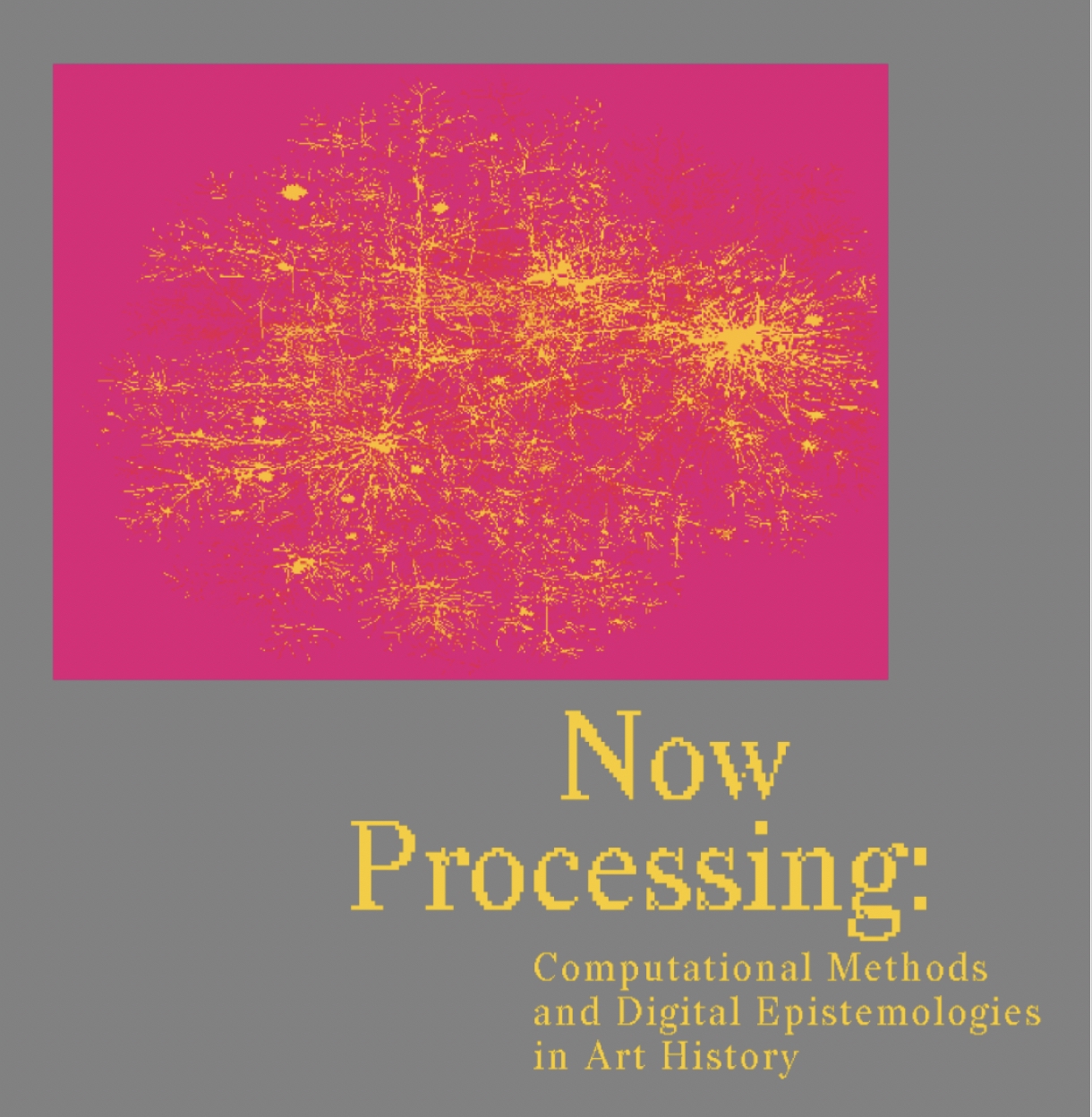
Now Processing explores how computational methods are reshaping research and knowledge production in Art History. The lecture series examines the ways digital tools not only extend traditional art historical research but also transform the epistemological assumptions underlying how artworks, their histories and modes of production are analyzed. It provides insights on the evolution of Digital Art History, tracing its development from early digitization initiatives and databases to contemporary practices involving large-scale data analysis, machine learning, and artificial intelligence.
The individual lectures address a range of methods, including data visualization, mapping as well as spatial and network analysis. Case studies highlighting different regions will illustrate how these approaches can challenge established canons, reveal previously overlooked connections, and enable new forms of cross-cultural and transregional inquiry.
As traditional art history has long been shaped by Eurocentric perspectives and epistemological frameworks rooted in Western historiography, the series also critically reflects on how computational methods may both reproduce and challenge these paradigms. In particular, it asks how the application of computational approaches can open new possibilities for attending to cultural and historical specificities.
Additionally, Now Processing considers the growing role of generative AI in contemporary image production and discusses how art history can develop critical approaches to analyze and respond to these emerging forms of visual culture.
Unter dem Titel Now Processing wird im Rahmen des Institutskolloquiums (IK) untersucht, wie sich computergestützte Methoden auf Forschung und Wissensproduktion in der Kunstgeschichte auswirken. Die Vortragsreihe im HS26 beleuchtet, wie digitale Tools nicht nur die traditionelle kunsthistorische Forschung erweitern, sondern auch wie sie die erkenntnistheoretischen Annahmen beeinflussen, die der Analyse von Kunstwerken, ihrer Geschichte und ihrer Produktionsweise zugrunde liegen. Das IK bietet Einblicke in die Entwicklung der digitalen Kunstgeschichte und zeichnet deren Verlauf von frühen Digitalisierungsinitiativen und Datenbanken bis hin zu aktuellen Praktiken nach, die gross angelegte Datenanalysen, maschinelles Lernen und künstliche Intelligenz umfassen. Die einzelnen Vorträge behandeln verschiedene Methoden, darunter Datenvisualisierung, Mapping und räumliche Analyse sowie Netzwerkanalyse. Fallstudien aus verschiedenen Regionen werden veranschaulichen, wie diese Ansätze etablierte Kanons in Frage stellen, bisher übersehene Zusammenhänge aufdecken und neue Formen in interkultureller und transregionaler Forschung ermöglichen. Da die traditionelle Kunstgeschichte lange von eurozentrischen Perspektiven und epistemologischen Rahmenbedingungen der westlichen Geschichtsschreibung geprägt war, reflektiert die Vortragsreihe kritisch, wie computergestützte Methoden diese Paradigmen sowohl reproduzieren als auch infrage stellen können. Insbesondere wird untersucht, inwiefern computergestützte Ansätze neue Möglichkeiten zur Berücksichtigung spezifischer kultureller und historischer Kontexte eröffnen. Darüber hinaus betrachtet Now Processing die wachsende Bedeutung generativer KI in der zeitgenössischen Bildproduktion und diskutiert, welche kritischen Ansätze die Kunstgeschichte entwickeln kann, um diese neuen Formen visueller Kultur zu analysieren und auf sie zu reagieren.
17.09.26
Golnaz Sarkar Farshi Inference vs. Evidence: The Role of Machine Learning in Art Historical Research
- Abstract:
Machine learning – the basis of deep learning and transformer models central to AI – is grounded in inferential statistics. Unlike descriptive statistics, which analyzes finite datasets, inferential statistics predicts unknown or future data from existing observations. It can, for instance, estimate housing prices by identifying correlations between relevant features, or predict the effects of a vaccine based on limited trials. Because it lacks access to future data or complete populations, it relies on heuristic methods that, while not exact, still enable meaningful predictions.
This lecture explores the implications of applying inferential statistics – via machine learning and AI – to art historical research. Unlike fields such as medicine or economics, historical inquiry assumes that its data already exists, even if it has not yet been discovered. Rather than predicting missing data, researchers seek it out in archives and other sources. From this perspective, predictions appear problematic, since historical data cannot be guessed but must be found.
Is the use of machine learning in art history therefore misguided? The lecture argues that its primary functions are fivefold: finding, mapping, comparing, categorizing, and counting. It examines the methodological implications of these functions and identifies when and where machine learning, despite its inferential nature, can be meaningfully applied in art historical research.
[English]
24.09.26
Paul Jaskot The Evolution of Digital Art History: Evidence as Data and Digital Art History as the Social History of Art
- Abstract:
Art history is almost by definition a field that rests on “big data.” Traditional methods of training as well as interpretation – such as iconographic analysis – have required scholars to accumulate vast amounts of knowledge about visual tropes, for example. We are long familiar with thinking typologically as well as encyclopedically about forms, functions, and artists. In a word, art history has been digital art history avant le lettre. What is the relationship between digital methods and canonical art historiographic traditions? How are digital methods a critical new intervention in the theory and practice of art history? How in turn did they grow out of foundational art-historical questions? This presentation will address the relationship between the development of digital methods and art history. It will locate debates in the digital humanities within the debates of art history itself, to see how the field illuminates the questions in another. By focusing on methodological concerns, I will argue that a more critical digital art historical practice can be integrated into (and interrogate) foundational art historical debates, above all in the social history of art.
[English]
15.10.26
Sunkyu Lee Mapping and Making Urban Space: Cartographic Variation and Clustering of Infrastructures in Ming-Qing China
- Abstract:
Despite the abundance of city maps in late imperial Chinese local gazetteers, both historical and art historical scholarship has rarely examined cartographic variation at a comparative, regional scale. Long understood as representations of an ideal city based on the imperial model of four-sided enclosure, gazetteer maps in fact reveal striking differences in how city walls were drawn, configured, and used to organize surrounding urban space. If these depictions were neither mechanically copied from earlier maps nor purely idealized, how did city maps visualize urban space? How did variations in form and attached structures encode differing meanings and functions of city walls, and how were these meanings reflected in what maps foregrounded – or marginalized – across different regions and periods?
This presentation examines city walls as cartographic organizing devices through which urban space was made legible and spatial relationships among different infrastructures were defined. It analyzes how maps depicted walls as structuring the representation of bridges, roads, and other key urban infrastructures, presenting urban space as a set of relational clusters of infrastructures reflecting regional and local interests rather than a fixed, state-imposed design.
[English]
12.11.26
Leonardo Impett Robots Leaving the Cinema
- Abstract:
This lecture develops the concept of neural exchange value (Impett & Offert, Meson Press 2026) as the general theory of value under contemporary machine learning. Neural exchange value names the process by which cultural artifacts, actions, and forms of knowledge are rendered commensurable and exchangeable once embedded in high-dimensional vector spaces, enabling their comparison, substitution, and optimization beyond media. Much of the current debate around generative AI remains focused on this first-order effect, where models simulate and standardize symbolic and cognitive labor. We see this largely as arbitrage of neural exchange value: for instance, in translating notes into an essay, a prompt into an image, etc.
The lecture argues, however, that recent generative video systems and so-called world models mark a critical threshold within this logic. Here, neural exchange value no longer operates primarily at the level of representation but becomes a mechanism for the capture of labor. By embedding vast cinematic archives of images and videos as dynamic, causal environments, these systems transform visual culture into a space of accelerated rehearsal, in which machines can simulate and optimize physical work faster than real time. Cinema becomes the privileged site of this transition not because of its aesthetic or narrative functions, but because it already encodes time, motion, and causality in a form directly usable for operational simulation. Visual culture leaves the cinema and enters the factory.
[English]
10.12.26
Nuria Rodríguez-Ortega Beyond Computation: How AI is Reshaping Art-Historical Method
- Abstract:
tba
[English]
***
Concept and organization/Konzept und Organisation: Daniel Berndt
Graphic design/Gestaltung: virgil b/g taylor
The lecture series is free and open to the public. For questions and accessibility needs, please write to Daniel Berndt, daniel.berndt@khist.uzh.ch.
Die Vortragsreihe ist kostenlos und öffentlich zugänglich. Für Fragen und Bedürfnisse zur Barrierefreiheit schreiben Sie bitte an Daniel Berndt, daniel.berndt@khist.uzh.ch.